
How To6 min read
Fur Everywhere: What Bathing and Brushing Actually Change
Bathing doesn't reduce shedding. It changes where the loose fur ends up — in the drain and the brush rather than on the sofa. Patchy hair loss down to visible skin is a different thing entirely, and that one belongs to a vet.
Bathing doesn't reduce shedding. It changes where the loose fur ends up — in the drain and the brush rather than on the sofa. Patchy hair loss down to visible skin is a different thing entirely, and that one belongs to a vet.
One correction first
"Reduces shedding" sells a lot of shampoo, and it isn't what happens.
Hair that sheds is hair that has finished its cycle. It's coming out either way. The only open question is where.
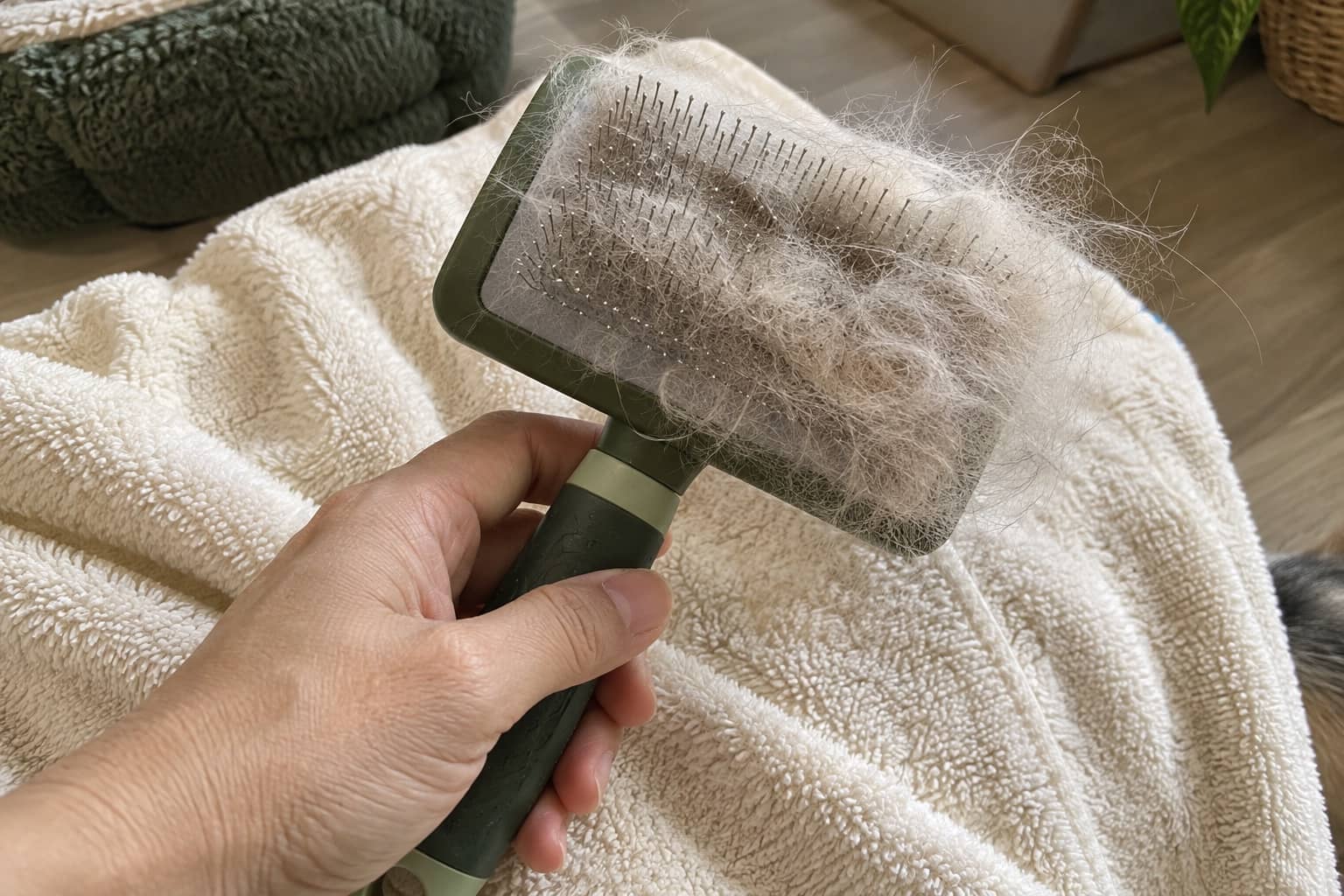
Bathing and brushing change the answer to that question. Hair that's already loose leaves in the drain during the bath, in the towel while you dry him, and in the brush afterwards — instead of coming off gradually onto your sofa and your clothes all week.
It's a much smaller promise than the packaging makes. It's also true, and it's enough to make a visible difference to the house.
Seasonal moults and double coats
Double-coated dogs — huskies, pomeranians, golden retrievers — have a period where the undercoat comes away in clumps. Owners call it blowing coat.
During that stretch, one bath with proper drying and brushing pulls out more hair than a week of casual combing, because warm water and moving air open the outer coat enough to let the loose undercoat escape.
In Thailand this is less defined than it is in cold countries. Plenty of double-coated dogs in Bangkok simply shed steadily all year instead.
The indoor cat with no season at all
This one puzzles a lot of cat owners.
A cat who lives entirely indoors experiences roughly the same light and temperature every month of the year, so his body never receives the signal that a coat change is due. Instead of moulting heavily and stopping, he sheds a little, continuously, forever.
With cats, regular combing does far more than bathing. It also cuts down on the hair he swallows while grooming himself.
Two or three minutes daily beats twenty minutes on a Sunday.
Brush damp, not soaking and not bone dry
The moment is after you've towelled him but before he's fully dry.
Soaking hair breaks when you pull on it. A fully dry coat has already set whatever knots formed during the bath.
Go once with the lie of the coat, then lightly against it. The second pass is the one that actually brings the undercoat out.
If you're buying one more tool, buy something that reaches the undercoat rather than a comb that only travels over the surface.
Where the shampoo comes in
It does contribute, just not where people think.
A shampoo that rinses cleanly leaves the hairs separating from each other once dry. Separated hair brushes properly, and a brush working properly is what removes the undercoat.
A shampoo that doesn't rinse leaves residue at the roots, the hairs stick together in sheets, and the brush skates over the top. Our 500 ml shampoo is built to rinse out easily for exactly this kind of reason. But don't expect any bottle to reduce how much he sheds, because none of them can.
What isn't normal
Normal shedding thins the coat evenly all over.
Hair loss in patches down to visible skin, with a defined edge, or skin that's gone red, changed colour, or scabbed over — that's something else.
It isn't a grooming problem, and no brush or bottle will fix it. See a vet.
Where neglected shedding ends up: matting
Hair that has shed but is still trapped in the outer coat is where a knot begins.
A small knot recruits the hair around it until it becomes a hard sheet lying flat against the skin. Past that point it can't be combed out, only cut — and by then the skin underneath is usually damp and irritated.
The first places it happens are behind the ears, in the armpits, and around the collar. Check those three every time you comb.
Three minutes every other day prevents all of it. The after-bath steps that stop tangles forming in the first place are here, and if you're still unsure how often to bathe at all, that's answered here.
The fur on the floor never truly ends. You do, however, get to choose where it collects.
Questions people ask us
- What causes shedding in dogs?
- Even shedding across the whole body is normal. Every hair has a lifespan and drops out on its own cycle, and how much depends on breed and season. Hair coming out in patches down to visible skin, or shedding alongside itching and a smell, is a different thing and worth a vet's opinion.
- Does bathing reduce shedding?
- It doesn't change how much hair falls out. It changes where it lands. Hair that's already loose comes away in the drain during the bath and in the brush afterwards, instead of shedding onto the sofa over the following week. That's a smaller promise than the advertising makes, and it's a true one.
- Is patchy hair loss normal?
- No. Normal shedding thins evenly all over and doesn't leave bare shapes. If you can see skin in patches with a defined edge, or the skin there has changed colour, gone red, or scabbed, that's a vet's problem rather than a grooming one.
- Why does my indoor cat shed all year?
- Because he has no seasons to follow. An indoor cat sees much the same light and temperature every month, so his body never gets the signal that it's time for a coat change. The result is a little bit shed continuously instead of a heavy moult and then nothing. Regular combing helps far more than bathing does.
Read next
 How Often Is Often Enough — and Why Dogs and Cats DifferOnce a week suits most dogs in a Thai home. An indoor cat can go far longer, or never. The right number depends on the coat, the weather and where he sleeps — and if the shampoo is gentle, more often does no harm. Red or flaky skin is the one sign to stop and see a vet.
 The First Bath: When, and How to Make It UneventfulA puppy or kitten is ready for a first bath when the vet says so, because the timing follows his own vaccination schedule. Until then, a warm cloth wrung out almost dry keeps him perfectly clean.
 Human Shampoo on a Dog? Dog Shampoo on a Cat?Human shampoo isn't built for a pet's skin. Once, in a pinch, is not a disaster — but it shouldn't become the habit. Dog shampoo on a cat is the riskier of the two, because a cat licks everything back off himself afterwards and swallows whatever was left in the coat.